
Interview with Ahvazi Award Recipient, Dr. Fatemeh Mortazavi

Dr. Fatemeh Mortazavi, a PhD graduate in Computer Engineering (Artificial Intelligence and Robotics) from the University of Tehran, was awarded the prestigious Ahvazi Award for her cutting-edge research on spatial working memory performance.
At the 12th edition of the Ahvazi Award (2025), following rigorous evaluations, the judging committee of the Iranian Neuroscience Society, with the support of the Cognitive Sciences and Technologies Council, selected and honored three outstanding researchers under the age of 35.
The Ahvazi Award—named in honor of the eminent 10th-century Iranian physician Ali ibn Abbas al-Ahvazi—symbolizes excellence and innovation in the fields of neuroscience and cognitive sciences.
Below is the full interview with Dr. Mortazavi.
What was the main research question of your study, and what methodology did you follow?
The primary goal of our study was to investigate how cognitive components influence performance in memory-based games. Specifically, we examined whether free eye movement during the encoding phase enhances spatial memory accuracy.
In this experiment, participants memorized the locations of cells within a hexagonal grid. Their performance was compared under two conditions: fixed gaze and free eye movement. Alongside accuracy and response time, we used eye-tracking indices and pupil diameter to precisely assess cognitive load.
The results demonstrated that both eye movement patterns and mental replay strategies play a critical role in memory efficiency.
What distinguishes your work from previous studies, and what added value does it offer to neuroscience?
Our main innovation lies in presenting a unified, multidimensional perspective. Unlike prior studies that examined factors such as stimulus quantity or spatial distribution in isolation, we analyzed their simultaneous effects, alongside individual selection strategies.
Moreover, for the first time, we applied these findings within the framework of Dynamic Difficulty Adjustment (DDA). This approach allows task difficulty to be defined not merely by stimulus count, but by users’ cognitive and behavioral characteristics.
From a theoretical standpoint, our results demonstrate that spatial working memory is not a static storage system, but rather an active process shaped by the interaction between visual perception and eye movements.
From an applied perspective, these findings provide a scientific foundation for designing user-centered cognitive games. By accounting for users’ mental strategies, systems can intelligently adapt difficulty levels, thereby maximizing both training effectiveness and cognitive engagement.
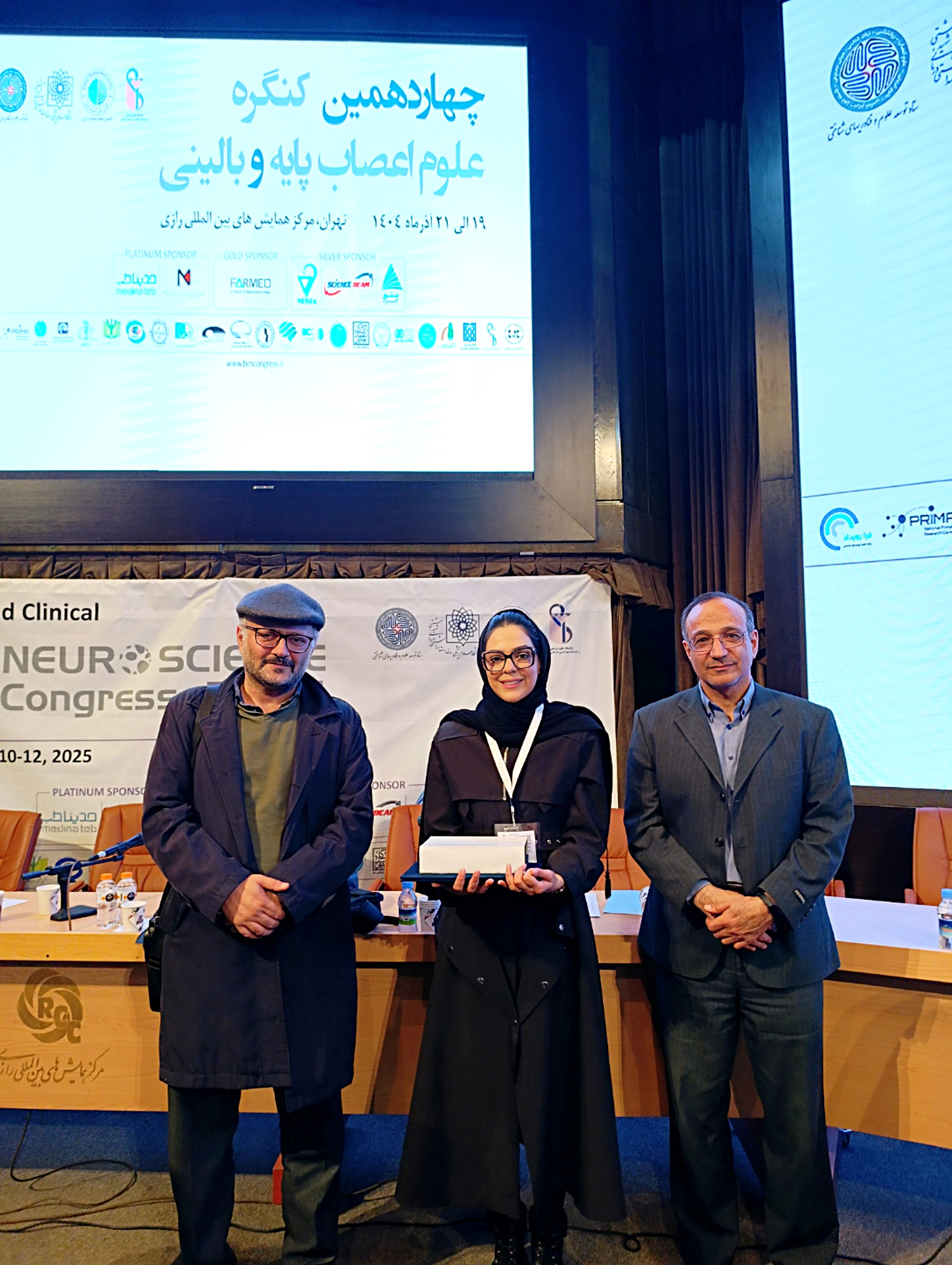
From right to left: Dr. Manouchehr Moradi (Supervisor), Dr. Fatemeh Mortazavi, Dr. Abdolhossein Vahabi (Supervisor)
What challenges did you face during this project, and what are your future plans?
One of the main conceptual challenges was accurately measuring task difficulty, which we addressed using a multidimensional approach. Task difficulty is not solely determined by the number of stimuli; factors such as spatial distribution and selection strategies also play crucial roles.
From a technical and operational perspective, synchronizing behavioral data with eye-tracking measurements, as well as controlling variables such as fixation, required careful experimental protocol design, mixed-effects statistical modeling, and prior participant training.
Our next step is to develop intelligent difficulty-adjustment systems and enhance human-like agents. These computational models, which simulate human behavior, can serve as the core engine of adaptive cognitive games.
What do you see as the research priorities of the next decade, and how could this work impact clinical treatment?
In the coming years, I believe that interdisciplinary research combining neuroscience with machine learning and artificial intelligence will become a top priority. This integration enables more precise brain modeling and the personalization of therapeutic interventions.
To advance this field nationally, it is essential to expand advanced laboratory infrastructures—such as neural recording and neuroimaging facilities—and to strengthen interdisciplinary collaboration among engineers, psychologists, and data scientists.
Within this context, our framework could evolve into a rapid screening tool for disorders such as ADHD within the next five years. By identifying individual cognitive limitations, personalized training programs can be designed to improve attention and memory in daily life.
Furthermore, human-like simulators allow for faster and more accurate evaluation of treatment effectiveness, reducing reliance on repeated testing with human participants.
What does receiving the Ahvazi Award mean to you, and what advice do you have for young researchers?
Receiving the prestigious Ahvazi Award has been an inspiring experience and a strong validation of the scientific path I have chosen. Beyond providing additional motivation, this achievement increases my responsibility to deliver rigorous and impactful results in future projects.
I encourage young researchers to always prioritize scientific curiosity and remain resilient in the face of challenges, valuable research is built through patience and perseverance. Equally important is striving not only to produce knowledge, but also to create real-world value by applying research findings to address societal challenges.
Your Comment :